
.webp?w=696&resize=696,0&ssl=1 "VMware Cloud Foundation 9.0 Launches with AI")
VMware has announced the general availability of VMware Cloud Foundation (VCF) 9.0, marking a significant evolution in private cloud infrastructure designed to handle modern workloads and AI-intensive applications.
The release addresses growing enterprise demands for data sovereignty, cost control, and performance optimization while providing the agility traditionally associated with public cloud services.
This major update represents VMware’s most comprehensive private cloud platform advancement, unifying operations and consumption experiences under a single interface while maintaining the robust foundation that enterprises have relied upon for decades.
VCF 9.0 introduces several groundbreaking technical enhancements that directly impact enterprise infrastructure performance and cost efficiency.
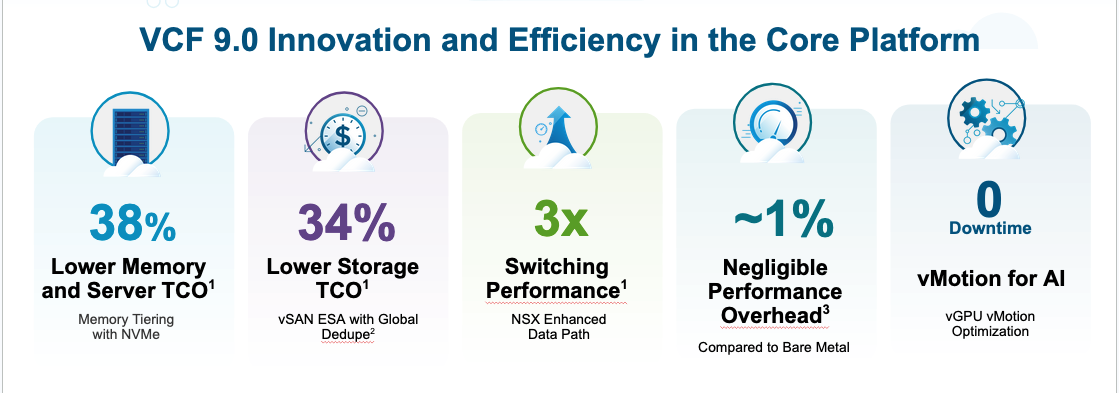
The platform now features Advanced NVMe Memory Tiering, which allows organizations to extend memory pools with high-speed flash storage, treating NVMe as a second-tier memory solution.
This innovation addresses the growing demands of high-frequency trading engines, in-memory analytics, and JVM-heavy applications that traditionally struggle with expensive and finite DRAM limitations.
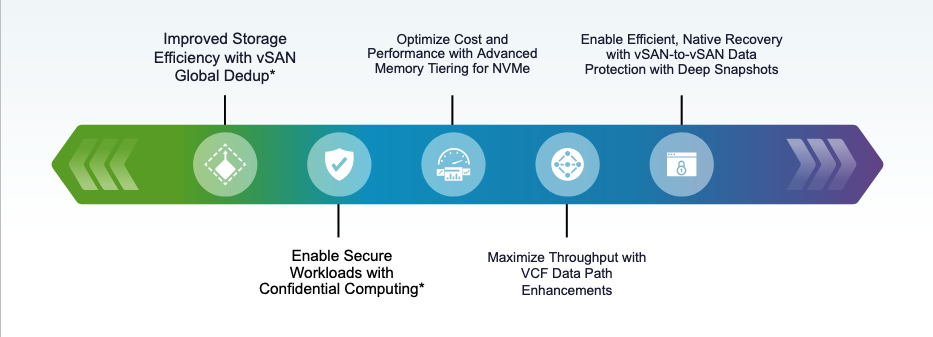
The release also incorporates vSAN Global Deduplication, extending block-level deduplication capabilities across entire clusters rather than individual disks.
This advancement enables organizations to protect and serve larger datasets on the same flash footprint without experiencing the performance penalties typically associated with post-process deduplication engines.
Additionally, enhanced data paths with kernel optimizations and optional DPU offload reduce latency for east-west traffic, particularly benefiting AI pipelines and microservice architectures.
VMware Cloud Foundation
At the heart of VCF 9.0 lies a fundamental shift toward unified operations and consumption experiences.
The platform now provides a single interface for both private cloud operations and cloud consumption, eliminating the traditional friction between operational teams and developers.
Fleet-wide health monitoring, patching, and compliance management are consolidated into one console, while developers access infrastructure through unified APIs including Terraform providers, REST APIs, and VCF Automation blueprints.
The platform enables organizations to run virtual machines and Kubernetes containers side-by-side as first-class citizens, with integrated Argo CD and native CI/CD hooks that streamline container deployments from repository to production.
VCF 9.0’s automation capabilities extend to simplified cloud networking and VPC consumption, where workload teams can declare virtual private clouds in code while routing, load balancing, and security configurations deploy automatically.
This unified approach significantly reduces learning curves for operators while removing deployment friction for development teams.
Security and compliance capabilities in VCF 9.0 are deeply integrated across all platform layers, addressing the increasingly complex threat landscape facing enterprise environments.
Compliance for Enterprise Workloads
According to Report, VMware Cloud Foundation 9.0 represents a paradigm shift in private cloud infrastructure, delivering the speed and flexibility of public cloud services.
The release introduces a comprehensive Security Operations Dashboard that overlays live attack-surface maps with real-time compliance scores.
Configuration compliance and monitoring features continuously scan runtime settings against CIS, NIST, and custom baselines, automatically flagging configuration drift and implementing auto-correction where policies permit.
The platform also includes advanced identity and certificate management with platform-wide identity federation and automated certificate issuance and rotation.
Data residency tags, geo-fencing policies, and automated compliance verification ensure that workloads maintain sovereign compliance requirements throughout their lifecycle.
Find this Story Interesting! Follow us on LinkedIn and X to Get More Instant Updates.

.webp?w=356&resize=356,220&ssl=1 "Microsoft Teams Blocking Users from Accessing Embedded Office Documents")


.webp?resize=1600,900&ssl=1&description=VMware has announced the general availability of VMware Cloud Foundation (VCF) 9.0, marking a significant evolution in private cloud infrastructure.)